A resume that reads like an engineer wrote it
Most engineering resumes read like a ticket queue. LaunchCV rewrites them with the language hiring managers actually scan for — latency, throughput, scope, ownership, baselines — and keeps formatting ATS-clean for how platforms like Workday, Greenhouse, and Lever parse resumes.
Pre-loaded keyword library
+ 200 more across Cloud, DevOps, Security, ML, and mobile. AI picks the right subset per JD.
Why it matters
A great software engineer resume is a parsing problem first
Strong engineers lose interviews to formatting, not talent. A clever two-column developer resume can read beautifully to you and arrive as garbled text to an applicant tracking system — so the review never happens.
LaunchCV treats the resume as an engineering resume ATS problem: clean structure in, quantified impact out. The tech resume AI keeps three things true at once:
- Impact is measurable — latency, throughput, scope, and ownership, not duty lists.
- Formatting is parseable — single-column layouts built for how major ATS platforms parse.
- Keywords fit the role — each posting matched with JD Alignment before you apply.
Inside the product
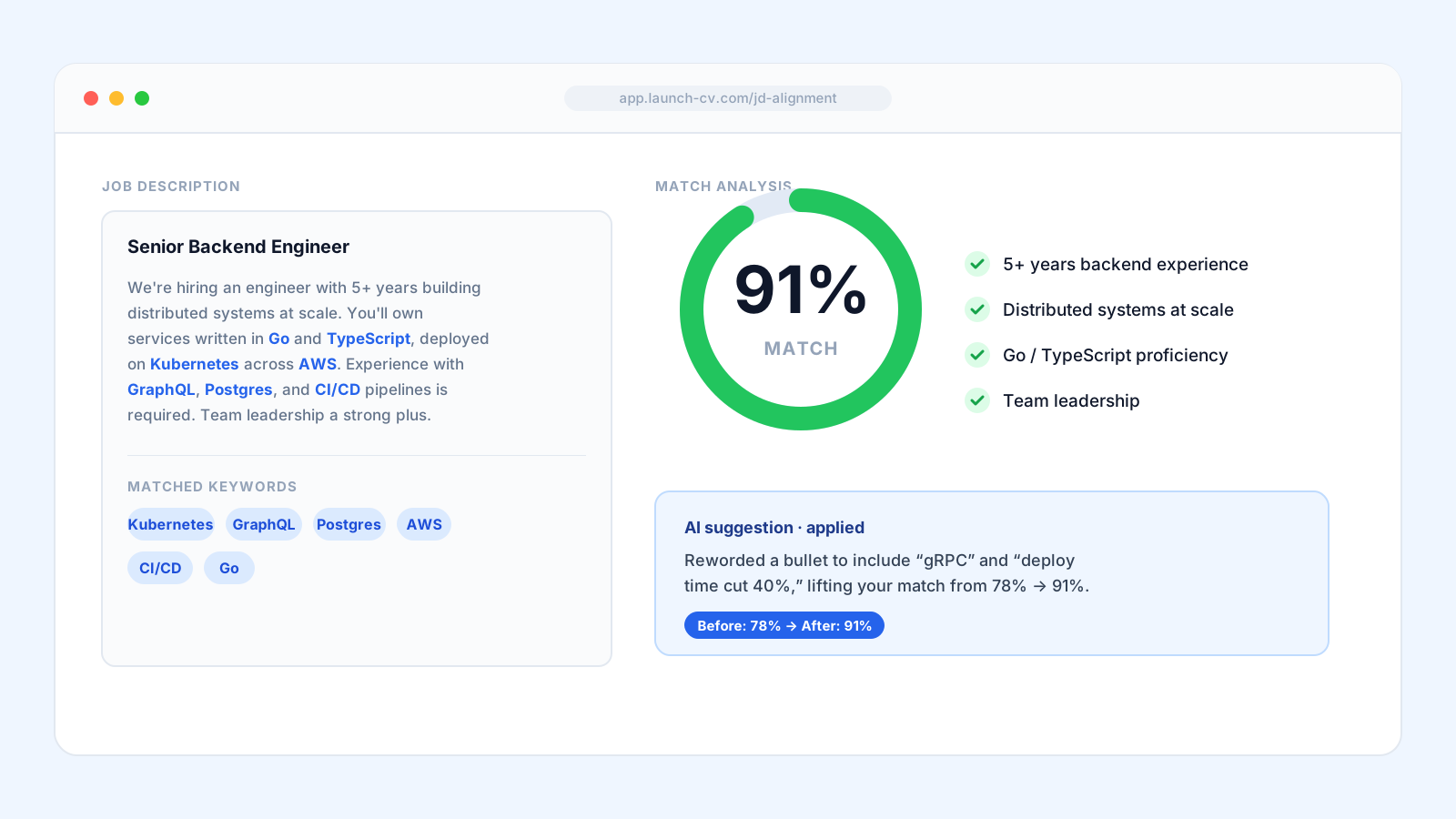
Matched to the exact engineering role
The diff · 3 real rewrites
What hiring managers actually want to read
Before
$ fixed slow db queries
After · AI rewrite
Cut p95 read latency from 240ms → 48ms on the payments service via index rewrites and connection pooling — saved an estimated $34k/yr in DB IOPS.
Before
$ shipped some features
After · AI rewrite
Owned end-to-end delivery of 7 features across Q3/Q4, growing weekly active dev seats by 28% (3.2k → 4.1k) on the IDE plugin.
Before
$ did some on-call work
After · AI rewrite
Led on-call rotation for tier-0 services (12-engineer roster, 24×7), cutting MTTR from 41 min → 9 min via runbook and alert hygiene.
Engineering-specific fixes
Built for the things you actually ship
Problem
Bullets sound like JIRA tickets
We fix it with
AI rewrites ‘fixed bug in payments’ as ‘reduced p99 checkout latency by 38% across 3 regions’.
Problem
Open-source isn't on the resume
We fix it with
Dedicated Projects section with stars, commits, and contribution role auto-detected from GitHub.
Problem
ATS rejects clever layouts
We fix it with
Engineering-tested templates: no tables, no graphics, no LaTeX-looking sidebars.
Problem
Senior signals don't pop
We fix it with
AI surfaces scope: team size, system tier, on-call rotation, RFC ownership.
Engineering sections covered
Not just Experience — all of the above
Tech stack
Cloud, languages, frameworks, datastores — grouped, deduped, ATS-parseable.
Open-source projects
Repo name, stars, commits, role. Maintainer or contributor — auto-detected from GitHub if linked.
System design
RFCs, architecture migrations, scale milestones (10× users, 100× requests, $X cost saved).
On-call and SRE
Rotation size, MTTR, incident leadership, postmortem ownership.
Certifications
AWS, GCP, K8s, security — with issue date and credential ID.
Publications and talks
Conference talks, blog posts, podcast appearances, internal RFCs cited externally.
How it works
Build a software engineer resume in five steps
LaunchCV combines an AI resume builder, JD matching, and an ATS check so your developer resume reads like impact, not a ticket queue.
Import or speak your experience
Paste your existing resume or describe each role in plain language — voice input works too.
Load a target job description
JD Alignment maps the required stack and seniority signals to what you already have.
Let AI quantify the work
Bullets are rewritten with latency, throughput, scope, and ownership — the signals hiring managers scan for.
Check the ATS score
Score your engineering resume 0–100 with our ATS check; templates avoid tables and graphics that break parsing.
Export and drill
Download PDF or DOCX, then run interview prep on the exact same role.
Why engineers use it
A generic builder vs. an engineering resume ATS engine
Most builders hand you a pretty template. LaunchCV handles the writing, the JD match, and the parsing risk that actually keeps a developer resume out of the pile.
| What hiring managers scan | LaunchCV | Generic resume builder |
|---|---|---|
| Impact metrics | Latency, throughput, and scope quantified | “Responsible for” duty lines |
| ATS formatting | Single-column, no tables — built for how ATS parses | Sidebars that scramble parsing |
| Keyword match | Stack aligned to each posting | One static skills list for every job |
| Projects & OSS | Dedicated, parseable Projects section | Buried or left off entirely |
| Seniority signals | Team size, on-call, and RFC ownership surfaced | A flat list of tasks |
| Proof | Free ATS score — no signup | No feedback loop |
A real use scenario
How Ravi turned ticket-speak into interviews
Ravi was a backend engineer with five years of solid work and a resume that read like a JIRA export: “fixed slow db queries”, “did some on-call work”. Recruiters were not calling.
He pasted a target job description into JD Alignment and let the tech resume AI rewrite. “Fixed slow db queries” became “Cut p95 read latency from 240ms to 48ms on the payments service via index rewrites and connection pooling”. His on-call line grew a roster size and an MTTR number. Nothing was invented — the AI just surfaced the scope he had buried.
Then he ran the ATS score checker, swapped his two-column layout for a single-column engineering template, and watched the score clear 90. Same career, finally legible to the parser and the hiring manager.
Explore the tools
AI Resume Builder
4 ATS-ready templates and quantified bullets.
JD Alignment
Match your resume to any job description.
ATS Score Checker
A 0–100 ATS readiness score.
Cover Letter Generator
A tailored letter in about a minute.
Interview Prep
Role-specific questions with model answer outlines.
Voice Input
Speak your experience, AI writes it.
Your code is good. Make the resume keep up.
Build my engineering resumeFAQ
Frequently asked questions
Write a software engineer resume with quantified bullets covering latency, throughput, scope, and ownership rather than task lists. LaunchCV rewrites vague lines like fixed slow db queries into metric-driven achievements, keeps formatting ATS-clean for Workday, Greenhouse, Lever and more, and picks the right keywords per job description.