Find out why your resume is getting filtered
Upload your resume. In seconds you get a 0–100 ATS score, a breakdown by parser dimension, and a prioritized list of every fix.
0–100
ATS score scale
Free
No signup
PDF/DOCX
Files accepted
80
of 100
Good — fixes recommended
Breakdown
2
High issues
4
Medium
6
Low
See it in action
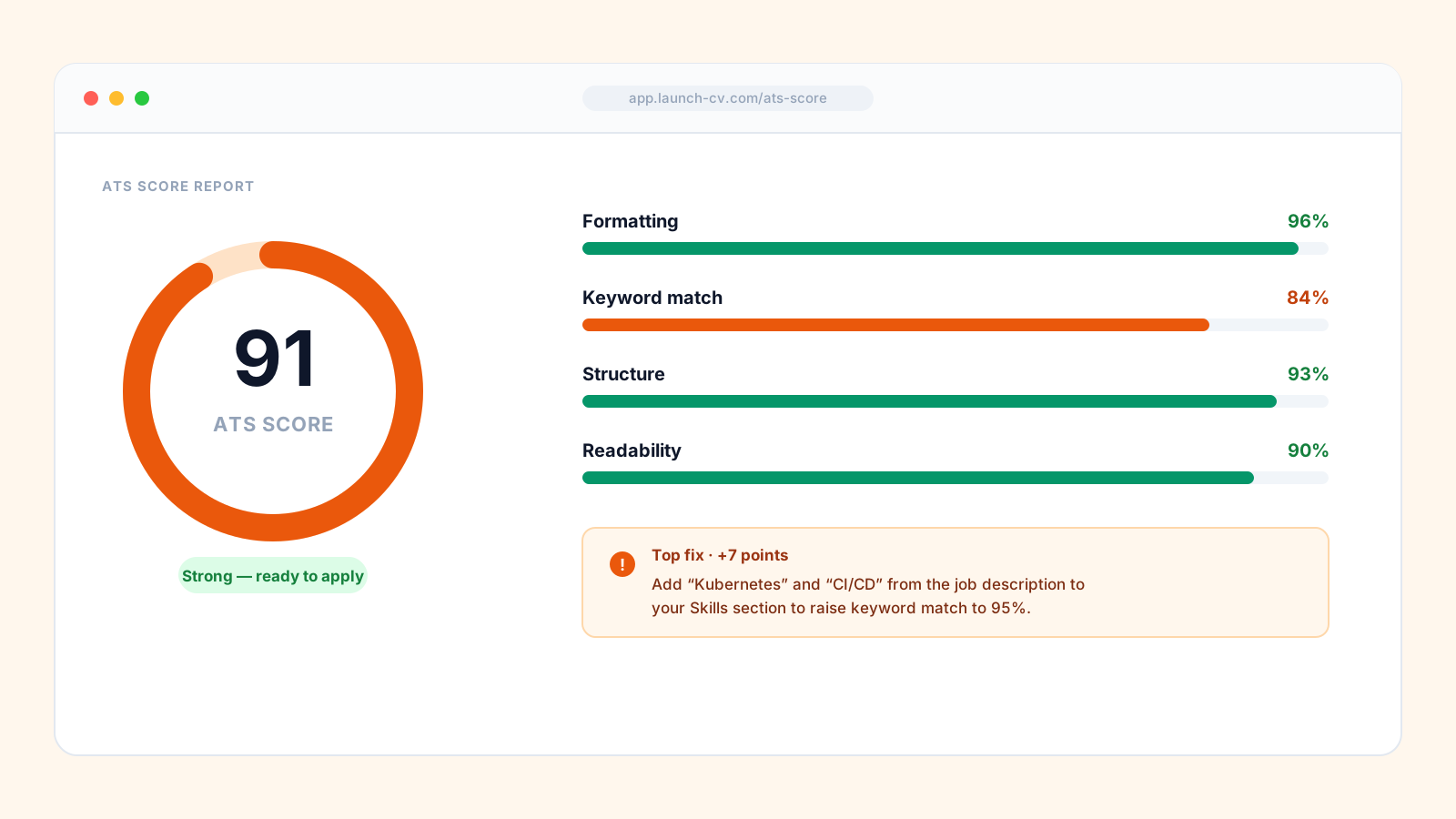
Your ATS score, itemized
Prioritized issue list
Every bug, named and ranked
Embedded text box in Experience
ATS parsers can't extract content from text boxes. Convert to plain paragraphs.
Multi-column layout
Two-column resumes break parsing order. Switch to single-column for ATS rounds.
Non-standard fonts
Some parsers fall back when fonts aren't embedded. Use Inter, Source Sans, or Arial.
Date format inconsistency
You mix ‘Mar 2022’ and ‘03/22’. Standardize on MMM YYYY.
Header graphic blocks contact parsing
Header art can hide contact info from ATS parsing. Move email and phone to the body.
What we test
Six dimensions, one score, zero mystery
Formatting parser
Catches tables, text boxes, columns, graphics, and header/footer issues that break ATS.
Keyword density check
Measures keyword richness against industry benchmarks for your target role.
File compatibility test
Validates file type, size, encoding, and font embedding for common ATS parsers.
Section structure audit
Confirms Work Experience, Education, Skills, and Contact Info are all parseable.
Date format consistency
ATS systems need uniform date formats. We flag every inconsistency.
Contact info parsing test
Ensures name, email, phone, and LinkedIn land in standard parseable positions.
Three-step process
Upload. Analyze. Fix.
Upload your file
PDF, DOCX, or pasted plain text. We parse it in seconds, the same way common ATS platforms would.
Get every issue named
12 categories of parsing failures detected, each tagged High, Medium, or Low priority with a specific fix path.
Apply the fixes and rescore
Fix inside LaunchCV or in your own tool. Re-upload to confirm — most users gain 20–40 points on round one.
The complete guide
How an ATS score checker actually works
An ATS score checker reads your resume the same way an applicant tracking system does — as a machine, not a person. Before a recruiter ever opens your application, software from Workday, Greenhouse, Lever, iCIMS, and a dozen others extracts your text, splits it into sections, and matches it against the job description. If the parser stumbles on a two-column layout or a name buried in a header graphic, your experience never registers — which is why so many strong candidates get no reply.
To check the ATS score of your resume, upload a PDF or DOCX and LaunchCV runs it through a parser built around how common ATS platforms read resumes. You get a 0–100 score in seconds, broken into four dimensions: formatting (can the text be extracted cleanly), keywords (does it contain the terms the role asks for), structure (are Work Experience, Education, Skills, and Contact Info all detected), and readability (is the language clear and quantified). Each dimension is scored independently so you can see exactly where the points are leaking.
What counts as a good ATS score?
A good ATS score is 80 or higher against the specific job you are applying to — not a generic template. Anything below 65 is at real risk of being auto-rejected. Because the score is relative to one job description, the same resume can score 92 for one role and 58 for another; that is expected, and it is why tailoring matters. Pair the score with JD alignment to match your resume to the job description before you submit.
The formatting mistakes that make a resume fail ATS
Most ATS parsing failures come from a short list of formatting choices: multi-column layouts that scramble reading order, tables and text boxes the parser cannot read, contact details trapped in a header or footer, decorative fonts that are not embedded in the file, and mixed date formats. LaunchCV flags every one of these on your resume by name, tags it High, Medium, or Low priority, and gives you a plain-English fix — then lets you re-score to confirm the gain. If you want the background first, read what an ATS score is and how it is calculated, or the step-by-step guide to checking your resume's ATS score.
Why check first
Guessing vs. an ATS resume checker
Most resumes are filtered by an applicant tracking system before a human ever opens them. A quick ATS resume test tells you exactly why — and how to fix it.
| What matters | ATS Score Checker | Applying blind |
|---|---|---|
| Score | A 0–100 ATS score in seconds | No idea why you are filtered |
| Coverage | Built for how common ATS platforms parse | One black-box upload |
| Issue list | Every problem ranked High, Medium, Low | Silent rejection, no reason given |
| Fix path | A specific fix for each flagged issue | Trial and error across dozens of applications |
| Typical result | A prioritized, plain-English fix list | Same resume, same silence |
| Confidence | Re-upload to confirm you pass ATS | Never know if it worked |
A real use scenario
How Sam found out his resume never reached a human
Sam had sent 40 applications for operations roles and gotten two rejections and 38 silences. The resume looked great to him — a polished two-column design with a header graphic and a custom font. That was the problem.
He uploaded it to the ATS score checker and got a score of 54 out of 100 in seconds. The report named the culprits: a text box the parser could not read, a multi-column layout that scrambled the reading order, and contact details trapped in the header graphic.
He switched to a single-column ATS-tested template, moved his email and phone into the body, and standardized his dates. On the re-check his score jumped to 91. The same experience, finally readable, started getting replies.
FAQ
Common questions
What is an ATS score checker?
An ATS score checker is a tool that simulates how applicant tracking systems parse and rank your resume, then returns a 0–100 score. LaunchCV checks your resume the way common ATS platforms — like Workday, Greenhouse, and Lever — parse it, and returns a prioritized list of every formatting and keyword fix.
How do I check the ATS score of my resume?
Upload your resume as a PDF, DOCX, or pasted plain text on the free ATS check page. In seconds you get a 0–100 ATS score, a breakdown across formatting, keywords, structure, and readability, and a fix list ranked High, Medium, and Low priority. No account is required to see your score.
What is a good ATS score for a resume?
Aim for 80 or higher, measured against the specific job description you are applying to. Scores below 65 are at high risk of being filtered out before a recruiter ever sees them. Each fix on your prioritized list is designed to move the needle — the score updates live as you apply them.
Why is my resume failing ATS?
The most common reasons a resume fails ATS parsing are multi-column layouts, text inside tables or text boxes, header/footer graphics that hide contact info, non-embedded fonts, and inconsistent date formats. The checker names each issue on your resume specifically and tells you exactly how to fix it.
Which ATS engines does LaunchCV test against?
LaunchCV's checker is built around the parsing rules common to widely used applicant tracking systems — like Workday, Greenhouse, Lever, and iCIMS — flagging the layout and formatting choices most likely to break in one of them.
Is the ATS resume checker free?
Yes. You can test your resume and see your ATS score and full parser breakdown for free, with no account. The one-click AI fixes and the rest of the toolkit (JD alignment, cover letters, interview prep) are on a paid plan.
Learn more in What is an ATS score? and How to check your ATS score.
See exactly what's broken, not just a number
Every issue is named and ranked — tables, fonts, header graphics, date formats — so you know precisely what to fix first.
Free, no account, no waiting
Upload once and get your score with a full parser breakdown. The rest of the toolkit is there when you're ready.
A 90+ ATS score changes everything
More score means more human eyes on your resume — and more interview replies in your inbox.
Check my ATS score free