Match your resume to any job in under a minute
Paste a job description. LaunchCV scores your fit, flags every missing keyword, and rewrites your bullets to close the gaps.
Before · 42% match
Helped team complete projects on time.
After · 91% match
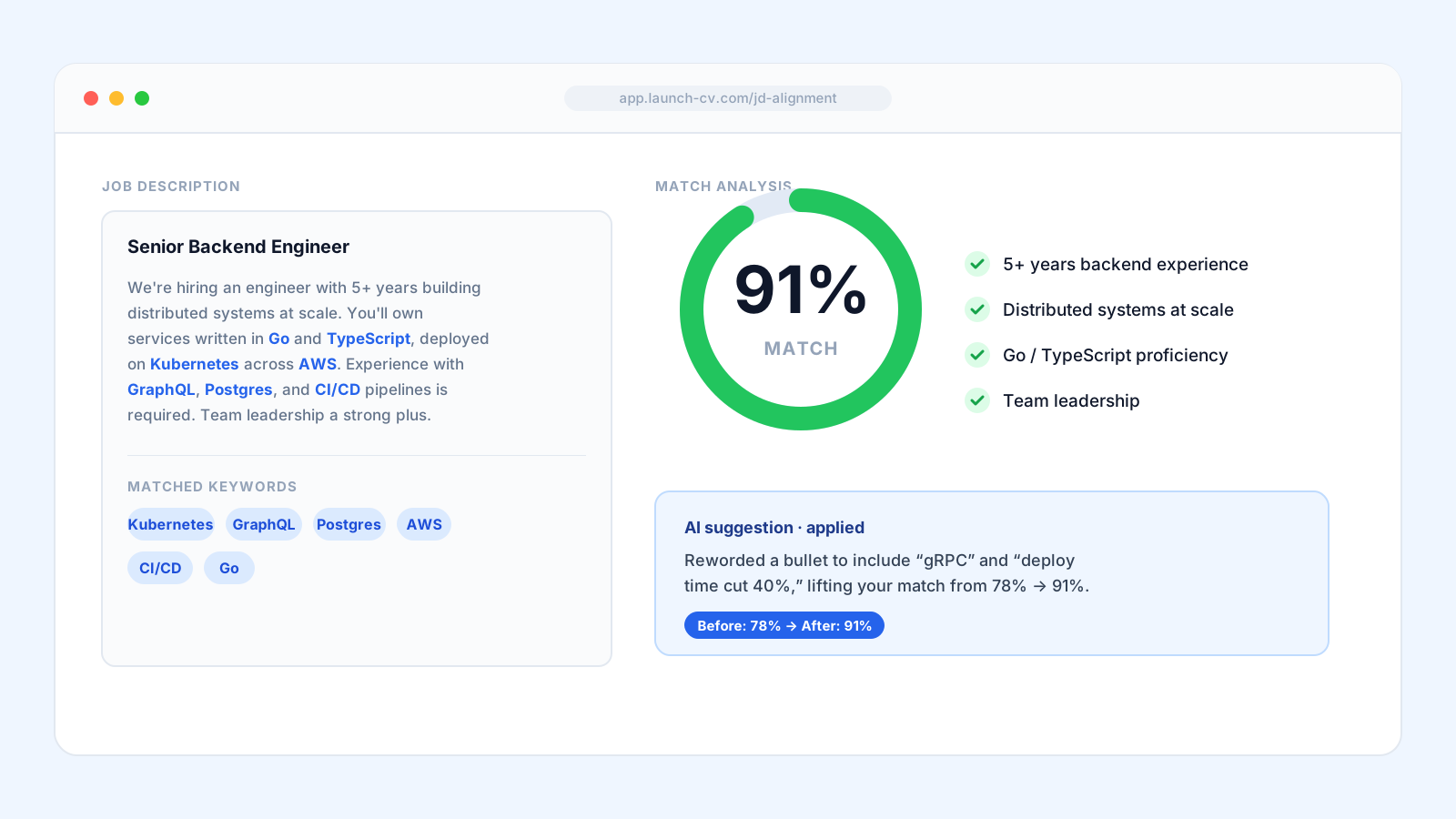
Led cross-functional delivery of 3 enterprise SaaS migrations, cutting time-to-deploy by 40% with Agile/Scrum.
Keywords inserted
+ 6 added
94%
ATS pass
91%
JD match
88%
Readability
See it in action
Watch your match score climb
+49
Average score jump
8 sec
Time to analyze
15
ATS engines tested
12
Industries calibrated
What you get
Six AI capabilities behind one button
Keyword extraction
AI parses every hard skill, soft skill, tool, and seniority signal in the JD.
Ranked gap analysis
Side-by-side view of what your resume has versus what the role asks for — sorted by impact.
AI bullet rewrites
Missing keywords woven naturally into your existing experience. No fabrication, no keyword stuffing.
Real-time match score
Score updates live as you accept changes. Aim for 90% or higher before submitting.
Multi-job tracking
Save scores across applications and compare which roles you fit best.
Built for real ATS platforms
Formatting is modeled on how systems like Workday, Greenhouse, Lever, and iCIMS actually parse resumes.
How it works
From paste to a tailored match in under a minute
Add your resume
Upload PDF or DOCX, or paste plain text. We parse it in under two seconds.
Paste the job description
From LinkedIn, Indeed, or any careers page. URL or raw text — both work.
Review your match score
AI extracts every requirement and produces your gap map in under ten seconds.
Approve rewrites
Accept AI suggestions one click at a time. The score updates as you go.
Export and apply
Download as PDF or DOCX, or push directly into the cover letter generator.
Track across roles
Save match scores per application and compare side by side.
The complete guide
How to match your resume to a job description
To match your resume to a job description, you first have to read the posting the way an applicant tracking system does: as a list of required skills, tools, and seniority signals. A recruiter using Workday or Greenhouse ranks every applicant against that list, so two candidates with identical experience can land on opposite sides of the filter purely based on how closely their resume mirrors the language of the role. That is why a generic resume sent to fifty jobs underperforms a tailored one sent to five.
LaunchCV automates the tailoring. Paste any job description — from LinkedIn, Indeed, or a careers page — and the AI runs a keyword gap analysis: a side-by-side map of what your resume already contains versus what the role asks for, ranked by impact. It then rewrites your existing bullets to fold in the missing terms naturally, so your match score climbs as each gap closes. The score updates live as you accept each change, and nothing is fabricated — anything the AI cannot support with your real background is flagged, not invented.
Tailoring vs. keyword stuffing
There is a real difference between tailoring a resume to a job description and keyword stuffing. Stuffing means padding your resume with terms you cannot back up; both modern ATS software and human reviewers penalize it. Tailoring means reframing the genuine work you have already done in the vocabulary the role uses — calling a project “cross-functional delivery” because it was, or surfacing the SQL you actually wrote. The result is an accurate resume that also happens to rank well.
Confirm the match before you apply
A high JD match is only half the job — the resume still has to parse cleanly. After you align, run it through the ATS score checker to see how your resume reads to ATS software and catch any formatting issues. For the underlying method, see our guides on checking your ATS score and choosing the right resume keywords.
Why it beats tailoring by hand
Manual editing vs. AI resume tailoring
Tailoring a resume to each job description by hand is slow and easy to get wrong. JD Alignment does the requirement mapping, keyword gap analysis, and rewrites for you.
| What matters | JD Alignment | Editing by hand |
|---|---|---|
| Requirement mapping | AI maps every JD requirement to your resume | Guesswork and copy-paste |
| Keyword gap analysis | Ranked list of exactly what is missing | You miss what you cannot see |
| Bullet rewrites | Reworded to match — no fabrication | Rewritten manually for each role |
| Match score | Live score you can lift up to 95% | No feedback before you submit |
| ATS optimization | Tuned for common ATS parsers | Formatting risk on every upload |
| Time per job | Seconds to match and export | 30–60 minutes per application |
A real use scenario
How Priya turned a 42% match into an interview
Priya had applied to a dozen product roles with the same resume and heard nothing back. She pasted one job description into JD Alignment and saw the problem in seconds: a 42% match, with six required keywords — roadmapping, OKRs, A/B testing, cross-functional, SQL, and stakeholder management — missing entirely.
Instead of rewriting from scratch, she accepted the AI rewrites one at a time. Each suggestion wove a missing keyword into experience she already had, and the match score climbed with every click. The keyword gap analysis went from a red list to a clean one.
She exported the tailored version, ran it through the ATS score checker to confirm the formatting was clean, and applied. The point was never to game the system — it was to make sure a resume that already fit the role finally read that way to both the parser and the recruiter.
FAQ
Common questions
How do I match my resume to a job description?
Paste the job description into LaunchCV alongside your resume. The AI extracts every hard skill, tool, and seniority signal in the posting, compares it to your resume, and shows a ranked list of the keywords and requirements you are missing — then rewrites your bullets to close the gap without fabricating experience.
What is a resume-to-job-description match score?
It is a percentage that estimates how closely your resume matches a specific job posting, based on the skills, keywords, and requirements the role asks for. LaunchCV updates the score live as you accept AI rewrites, so you can watch it climb as you close each gap before you apply.
What is keyword gap analysis?
Keyword gap analysis is a side-by-side view of what your resume already contains versus what the job description requires, sorted by impact. It shows exactly which terms — like Agile/Scrum, roadmapping, SQL, or OKRs — are missing so you can add the ones you can honestly claim.
Does tailoring my resume to each job actually help?
Yes. Applicant tracking systems rank resumes against the exact job description, so a resume tuned to one posting scores far higher than a generic one. Tailoring the keywords and framing to each role is one of the highest-impact things you can do to get past the ATS filter and reach a recruiter.
Does it fabricate experience or keyword-stuff my resume?
No. LaunchCV weaves missing keywords into your real, existing experience and flags anything it cannot support with your background. It never invents roles, employers, or numbers. Modern ATS software and human reviewers both penalize keyword stuffing, so the goal is an accurate resume that genuinely matches the role.
Can I tailor my resume for multiple jobs at once?
Yes. LaunchCV saves a separate match score per application, so you can compare which roles you fit best and reuse a strong base resume across every posting. You tailor each one in about a minute against its job description, instead of rewriting your resume from scratch each time.
Pair it with the resume builder and interview prep, or compare plans.
Why it works
Built to close the gap, not just measure it
See the gap, not just the score
A ranked list of exactly which requirements your resume is missing — not just a number, but what to do about it.
Rewrites, never invents
AI weaves missing keywords into experience you actually have. It won't fabricate a skill, a tool, or a project you didn't do.
Stop guessing what recruiters want
Let AI show you exactly how to match the job — and rewrite your resume to prove it.
Run my first alignment